How Gut Bacteria and Bile Acids Team Up to Drive Liver Inflammation
A new review from Lanzhou University maps out how bile chemistry, bacteria living in the bile ducts, and the immune system feed into each other — turning cholestatic liver disease into a self-reinforcing loop rather than a single broken pathway.
The Core Issue
Cholestatic liver disease covers a group of conditions where bile flow gets blocked or disrupted — primary biliary cholangitis, primary sclerosing cholangitis, biliary atresia in children, gallstone disease, and several inherited disorders among them. Doctors have long suspected gut and bile-duct bacteria play some role in making these conditions worse, but most research has looked at bile acid toxicity, immune dysfunction, and genetics as separate stories. This review pulls those threads together into one framework.
Get the checklist before you trust another gut health headline.
Every week a new study claims one probiotic strain will fix everything. We built a 5-point checklist that shows you which microbiome claims are backed by real trials and which ones are riding on 8 mice and a press release.
The Finding
The authors propose what they call a "tripartite interplay" between three systems: bile composition, the biliary microbiome, and host immunity. None of the three moves independently — each one reshapes the other two.
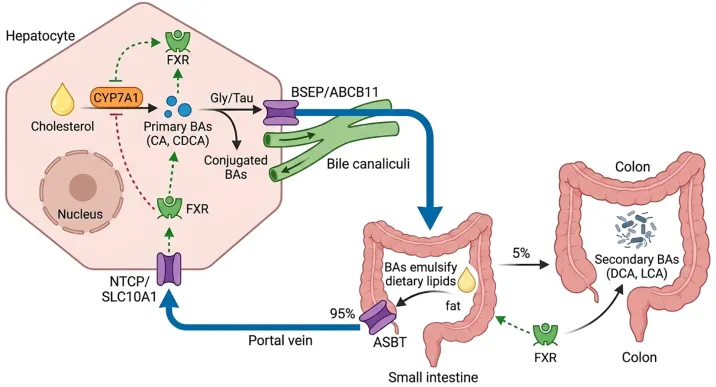
When cholestasis sets in, bile acid levels build up in the liver and blood, and the mix shifts: primary bile acids rise while secondary bile acids (the ones gut bacteria normally produce by transforming primary ones) fall, and the balance tips toward more hydrophobic, more damaging bile acid types. That chemical shift changes which bacteria can survive in the bile ducts — bile acids act like a natural antimicrobial, so as their concentration and character change, they open the door for opportunistic bacteria such as Klebsiella pneumoniae and E. coli to move in and dominate.
Those bacteria don't just sit there. Fragments of their cell walls and other microbial signals get picked up by immune receptors (Toll-like receptors and related pattern-recognition systems) on bile duct cells and immune cells, triggering inflammatory signaling pathways. That inflammation, in turn, feeds back into the bile acid pool and the microbial community, pushing the whole system further off balance and, over time, toward scarring and fibrosis.
The review also notes that the balance can tip the other way: certain secondary bile acids, like isoallolithocholic acid, actually encourage regulatory immune cells that dial inflammation down, while others suppress that same protective response. Which way the system tips depends heavily on which specific bacteria and bile acids are present — not just how much inflammation is happening.
Why It Matters
Framing cholestatic liver disease as a feedback loop rather than a single broken pathway changes how you'd think about treating it. If bile chemistry, bacteria, and immunity are all driving each other, then treatments aimed only at calming the immune response are working on one leg of a three-legged problem — which may explain why immunosuppressive therapy has had limited success in conditions like primary sclerosing cholangitis. The review argues that therapies targeting the microbiome or bile acid metabolism directly could interrupt the loop earlier, before it drives fibrosis, rather than just treating inflammation after the fact.
The review also breaks down how this three-way interaction plays out differently across specific diseases: primary biliary cholangitis looks more immune-driven, primary sclerosing cholangitis looks more gut-driven (it's closely tied to inflammatory bowel disease), biliary atresia in infants looks driven by early-life microbiome development, and inherited conditions like PFIC look driven primarily by defective bile acid transport. That distinction matters for treatment — a one-size-fits-all approach probably won't work across such different starting points.
Limitations of the Study
This is a review article that synthesizes existing research rather than reporting new experimental data, so it doesn't add fresh evidence on its own. The authors are upfront that bile sampling is invasive — it typically requires procedures like ERCP or surgery — which limits how much large-scale, well-controlled human data exists in this field to begin with. They also note that microbiome and bile acid patterns vary a lot between individuals and even between ethnic populations, which makes it hard to standardize microbiome-based diagnostics or treatments like fecal transplants. A conflict-of-interest statement is included and states no competing financial interests were declared.
Interesting Statistics
- Impact Metrics: Frontiers in Immunology's Microbial Immunology section carries a 7 impact factor and 11.3 CiteScore.
- 95% Recycled: Roughly 95% of bile acids are normally reabsorbed and recycled through the liver; only about 5% reach the colon, where gut bacteria convert them into secondary bile acids.
- 5–10% Complication Rate: An estimated 5–10% of PSC patients undergoing ERCP experience complications like pancreatitis or cholangitis, one reason large bile-sampling studies remain scarce.
Useful Takeaways
The authors argue that single-target treatments — an antibiotic here, an anti-inflammatory there — are likely insufficient given how tightly bile chemistry, bacteria, and immunity are linked. They point toward combination strategies instead: bile acid receptor drugs (like FXR or TGR5 agonists), microbiome-directed approaches (precision antibiotics, probiotics, or fecal transplants), and anti-inflammatory therapies matched to a patient's specific disease subtype and molecular profile. They call for future research to combine single-cell sequencing, spatial transcriptomics, and multi-omics data to figure out which piece of the loop — bile chemistry, microbiome, or immune signaling — is the best target for a given patient.
TL;DR
A new review proposes that cholestatic liver disease runs on a self-reinforcing loop: disrupted bile flow changes bile acid composition, which reshapes the bacteria living in the bile ducts, which in turn triggers immune signals that drive inflammation and scarring — and that inflammation feeds back into bile chemistry again. The authors argue treatments that hit only the immune response are addressing one part of a three-part cycle, and that future therapy should target bile acid metabolism, the biliary microbiome, and immunity together rather than in isolation.